

Part I
What Happens If Magnet Supply Stops
On 4 April 2025, China's Ministry of Commerce began requiring export licences for seven rare earth elements, along with the magnets that contain them. The seven are samarium, gadolinium, terbium, dysprosium, lutetium, scandium and yttrium. China's export controls had been tightening for two years, and the announcement still caught medical device makers with no stockpile policy and no second supplier on file.
Rare earths sit inside many medical devices. Every joint motor in a surgical robot contains a permanent magnet made from neodymium, iron and boron. These magnets produce an unusually strong field for their size, which is why the motors fit inside a robotic arm and still move a surgical instrument with the force and precision that surgery needs. Two of the seven elements on the April list, dysprosium and terbium, are added to these magnets to keep them stable as the motor heats up. A six-axis surgical robot has at least six of these motors running inside a sealed sterile environment, and all of them depend on materials that now need a Chinese government licence to export.
The same supply chain runs through MRI and CT scanners, rehabilitation robots, powered prosthetics and endoscopic cameras. These are very different devices that depend on the same materials.
Despite the name, rare earths are not scarce in the ground. Cerium, one of the seventeen, is roughly as common in the earth's crust as copper. The hard part comes after mining. The ore comes out mixed with other elements and with the host rock, and separating it takes a long sequence of chemical steps that industry spent decades working out. China built its processing capacity over thirty years, in facilities that took on environmental costs other governments would not accept.
China accounts for roughly 85 to 90 per cent of global rare earth processing. In 2024, Chinese facilities produced an estimated 300,000 tonnes of the neodymium-iron-boron magnets used in medical devices, electric vehicles, defence systems and industrial equipment. MP Materials, the most advanced rare earth producer outside China, made its first commercial batch of these magnets in the final quarter of 2025.
In supply chain terms, the medical device sector has been a free rider. Defence procurement offices have published rare earth vulnerability assessments since at least 2010. After a 2010 Chinese export embargo, the electric vehicle industry spent years building more diverse supply arrangements, because it had to. Medical devices used the same materials in smaller volumes and never faced the same pressure. The April 2025 licensing rules were the first time that position cost them anything.
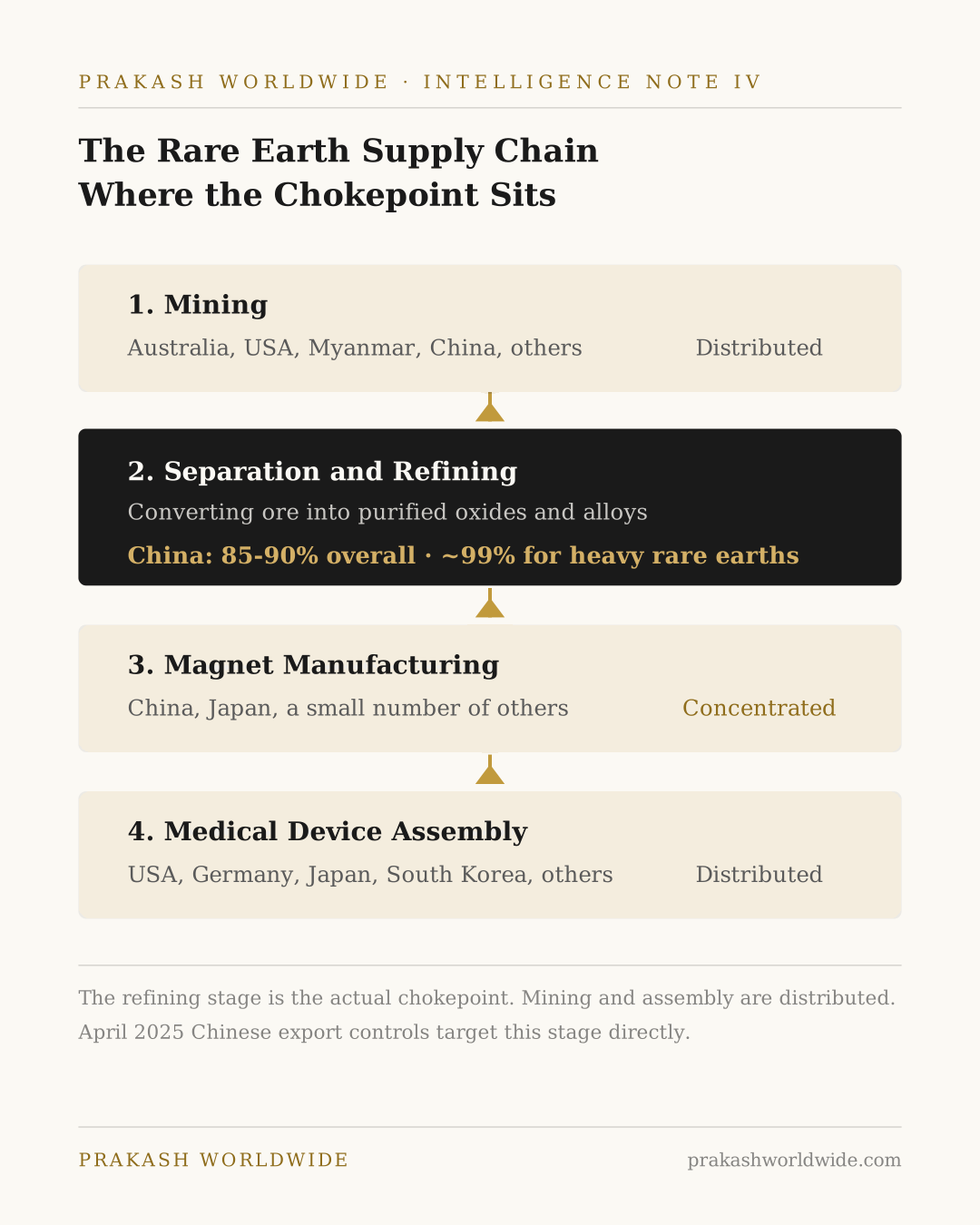
Figure 1. The rare earth supply chain by stage. Refining is where supply is most concentrated, while mining and assembly are more spread out.
Part II
Why Waiting Gets Harder
The concentration in processing has been visible for years. Government reports and procurement risk assessments in Washington, Brussels and Tokyo have all documented it. Since August 2023, China has started using that position as leverage, and the pace has picked up.
That month, China's Ministry of Commerce announced export licensing requirements for gallium and germanium, both used in semiconductors. Fourteen months later antimony joined the list. In April 2025 came the rare earth elements and magnets. Then came extraterritorial rules that extend Chinese licensing requirements to foreign-made products containing Chinese rare earths above a 0.1 per cent value threshold.
China tested the reaction after each step before announcing the next, and the affected industries were slow to respond every time.
All of this is happening inside a rivalry between the United States and China that has been hardening for a decade and shows no sign of reversing. Neither government is likely to be moved by a trade negotiation or a diplomatic gesture now. Washington has been using technology controls and industrial policy to pull supply chains out of China. Beijing has answered by tightening its hold on the materials those supply chains run on. The rare earth controls are one example, and they show how much can be done by applying pressure a step at a time.
Medical device companies have mostly watched this from a distance. The industry has never thought of itself as a geopolitical actor. Its products are used in hospitals and regulated by health authorities. To most buyers, a US-China technology rivalry feels far removed from a decision to purchase a surgical robot. That distance is part of why the April 2025 controls drew no response. Medical device companies had no process for linking the two.
Taiwan is the other exposure. Its semiconductor risk is discussed so often that it has become a standard scenario for technology supply chains. Its magnet industry gets far less attention. Taiwan has established producers and a government programme aiming for substantial domestic rare earth magnet output by 2030. The targets are ambitious next to current production, given that China made 94 per cent of the world's sintered permanent magnets in 2024. Still, it is one of the few attempts of any size to build processing capacity outside mainland China. A disruption in Taiwan would hit the medical device supply chain at the same moment it hits semiconductors, so the two shortages would arrive together.
Since 2023 the sector has had less time each year to deal with this on its own terms.
Part III
Where Private Capital Can Act
Governments have noticed the supply chain problem, which changes the picture for investors. The US Department of Defense put money into MP Materials in 2025 to speed up domestic rare earth magnet production. The EU Critical Raw Materials Act sets binding targets for domestic processing of strategic minerals, backed by a pipeline of funded projects. Japan, Australia and Canada have similar programmes. Governments are spending a great deal on the problem, which gives private capital projects to invest in alongside public funding.
$400 million in equity and a $150 million loan. The size of the US Department of Defense's 2025 commitment to MP Materials.
Upstream processing. Refining and separation is where the concentration is highest and where government money is flowing fastest. For a private investor, the best targets are companies that already have processing technology and permitted sites, since those take the longest to get. A company that has worked out the chemistry and cleared the regulators is much closer to production than an exploration-stage miner. Deal flow here is still limited, but it has grown since 2023 as government programmes have shown which operators are credible.
Magnet recycling. A spent NdFeB magnet holds the same rare earth content it had when new. The technology to recover it works at laboratory and pilot scale. It has not yet competed on cost, because collection is fragmented and processing has been more expensive than virgin material. That is changing as rare earth prices react to supply worries and as European and American rules begin to require manufacturers to show supply chain resilience and recycled content. A recycler that solves the feedstock problem, through hospital networks or direct deals with device makers, would be selling into a market created partly by regulation. Investors who build that position early will not have to compete later with the procurement budgets of large industrial companies.
Design changes. Some medical device categories that depend on rare earth magnets could be redesigned around other motor types, such as ferrite-based systems, switched reluctance motors or designs that use much less NdFeB. This will not work everywhere. A surgical robot at the limit of mechanical precision has less room to change its motor than a powered hospital bed or a rehabilitation device. Across many applications, though, the engineering is under way, and the companies doing it well are building more than a product improvement. To a large OEM under procurement pressure they are strategically valuable, and their valuations usually do not reflect that yet.
Government spending matters here because it pays for infrastructure that private capital would otherwise have had to fund. Western procurement programmes are creating qualified suppliers and validated processing plants, and they send demand signals that help medical device applications even though medical devices are not their main target. The sector has not yet shown up as a buyer in this market. Once it does, the entry points open today will look different.
Part IV
How the Three Options Compare
The three options in Part III are not interchangeable, and treating them as one category does not help an investor decide where to spend time. For that reason this note does not end with a single recommendation.
Upstream processing needs the most capital and moves the slowest. Government co-investment makes it more accessible, but the timelines are long, and the exit needs either a strategic buyer with a supply chain motive or a public market that has priced in the scarcity. Investors who have done well here know the sector and are patient enough to work alongside government, which not everyone is.
Magnet recycling is earlier in its development but has a clearer path to cash flow once the feedstock problem is solved. The technology risk is lower than it was five years ago. The market risk is lower than it looks, because regulation is creating the demand instead of waiting for companies to adopt it. The hard part is building collection and processing before a better-funded competitor does. It is a race with a visible finish line, which makes it a different investment from processing capacity.
Design changes are the hardest to judge. The value is in the engineering, and telling which companies are solving a real substitution problem takes technical expertise. A company that can remove rare earths from a high-value device without losing performance is worth much more to a large OEM under procurement pressure than its revenue suggests. An investor who finds those companies before the OEMs do has the advantage.
Timing matters for each of them. The medical device sector came late to this problem, and that gives a well-informed private investor an opening. Government programmes in the US and Europe are building market infrastructure, and large industrials and defence primes are starting to move procurement budgets into the space.
Prasun Prakash
Founder, Prakash Worldwide
Prakash Worldwide produces intelligence for principals who need to see clearly before they move. If this note raised questions worth pursuing, we are the right conversation to have first.
connect@prakashworldwide.com Get in TouchThis note is produced for informational purposes only and does not constitute investment advice. Prakash Worldwide does not hold positions in any securities referenced herein. © 2026 Prakash Worldwide. All rights reserved.