Part I
The Capital That Is Finding Its Footing
I have walked the floor at the World Health Expo in Dubai more than once. Each time, the scale requires a moment to absorb: 270,000 healthcare professionals, 4,800 exhibitors, delegations from 180 countries across two venues. The 2026 edition moved to Expo City Dubai and expanded by over 11,000 square metres, its footprint growing in step with an event that has become, in the space of a few years, the most consequential gathering in global health. For one week in January, Dubai is the centre of gravity for this industry. That did not happen by accident.
What strikes me each time is not the scale on display. It is the quality of the regional private capital beginning to engage with it, quietly and selectively, but with a seriousness that was not there five years ago. Family offices that built their wealth in real estate and hydrocarbons are sending representatives to these halls. Sovereign-adjacent funds are co-investing alongside international MedTech operators. The conversation has shifted, and the direction it is moving is clear.
The timing matters. GCC healthcare systems are scaling rapidly, in capacity, in sophistication, and in the technology being embedded within them. Only 10 to 15 per cent of GCC healthcare is currently digitised. For private capital with long horizons, that number describes the size of the market still to be built.
The GCC medical device market doubles to $36 billion by 2035. The global AI in medical devices segment is expanding at a CAGR of 44 per cent. The institutional capital has not arrived yet.
The numbers are substantial. The GCC medical device sector stands at $17 billion today and is projected to reach $36 billion by 2035. The AI-enabled medical device segment is the fastest-moving in global MedTech, expanding at a CAGR of 44 per cent. Da Vinci robotic systems alone performed 2.68 million procedures in 2024, up 17 per cent in a single year, with 13 to 16 per cent growth projected for 2025. GCC healthcare expenditure is projected to reach $159 billion by 2029, growing at 7.8 per cent annually. Saudi Arabia has committed $100 billion to artificial intelligence, with healthcare infrastructure as a central pillar of that programme.
The GCC family office market is anchored by over 800 family-related structures at the DIFC alone, collectively managing more than $1.2 trillion in assets, figures confirmed in DIFC's own 2024 annual results. This is patient, multigenerational capital, structurally well-suited to the timelines of healthcare technology, which rewards those who enter early and hold through the regulatory and commercialisation cycles that deter investors with shorter horizons.
Dubai is not hosting the world's healthcare conversation merely as a convening point. WHX Leaders, the invitation-only summit aligned with UAE Vision 2031, launched in February 2026 with a precise ambition: to position the UAE as a global centre for health leadership, not a venue that hosts others doing it. The launch of WHX Tech in September 2025, held under the patronage of the UAE Ministry of Health and Prevention, was another step in the same direction. The country is building the testbed. The infrastructure, the regulatory frameworks, the data systems are all moving in the same direction, with a clarity of intent that private capital has begun to recognise.
Part II
What MedTech Actually Means For a Private Investor
I understand why family offices hesitate. MedTech still conjures drug trials, binary clinical outcomes, decade-long regulatory timelines, scientific opacity that makes diligence feel like a specialist sport. For a private capital investor in 2026, the picture is considerably more familiar.
Strip away the pharmaceutical adjacencies and you have largely a technology and infrastructure business, one that delivers recurring revenue, generates high switching costs once embedded in clinical workflows, and serves markets driven by demographics. Sentiment has little to do with it. Ageing populations, rising healthcare capacity, governments expanding the technology in their systems. None of these are discretionary trends. They compound.
That compounding is most visible at the intersection of artificial intelligence and surgical robotics. Robotic surgery is no longer a premium option in tertiary hospitals. It is becoming standard of care. Da Vinci systems performed 2.68 million procedures in 2024, up 17 per cent on the prior year, with 13 to 16 per cent growth projected for 2025. AI-assisted diagnostics, where trained algorithms read imaging data faster and in several validated studies more accurately than unassisted clinicians, is the fastest-growing segment in the entire MedTech universe. The FDA had authorised over 1,250 AI and machine learning-enabled medical devices by July 2025. A decade earlier, approvals in this category were counted in the dozens.
India's surgical robotics market grows from $851 million to nearly $4 billion by 2031. Over 70 per cent of its medical devices are still imported. GCC investors are better positioned to move here than almost anyone else.
India warrants specific attention. It is the fourth largest and fastest-growing surgical robotics market in Asia Pacific, on a path from $851 million in 2023 to nearly $4 billion by 2031, figures confirmed by the US International Trade Administration. Over 70 per cent of its medical devices are still imported, a structural dependency that is simultaneously a procurement reality and a long-term localisation opportunity. For GCC family offices with existing commercial exposure to India, through trade relationships, diaspora networks, or direct holdings, this is a chance to extend relationships already in place into a sector moving fast enough to reward early positioning.
The asset class offers several distinct risk-return profiles. Early-stage companies building clinical AI platforms carry higher risk alongside higher return potential, appropriate for a venture allocation within a broader portfolio. Growth-stage MedTech businesses with established procedure volumes or subscription revenue are the natural territory of direct minority stakes. Private credit to digital health platforms with recurring income streams offers a low-correlation instrument that larger family offices are beginning to use precisely because it behaves differently from their equity book. Roll-up strategies in specialist devices and digital health infrastructure, particularly in markets where consolidation is early, represent a category that generalist private equity has underserved.
That requires sector literacy, disciplined access to deal flow, and diligence grounded in how these businesses actually operate, beyond what their decks show.
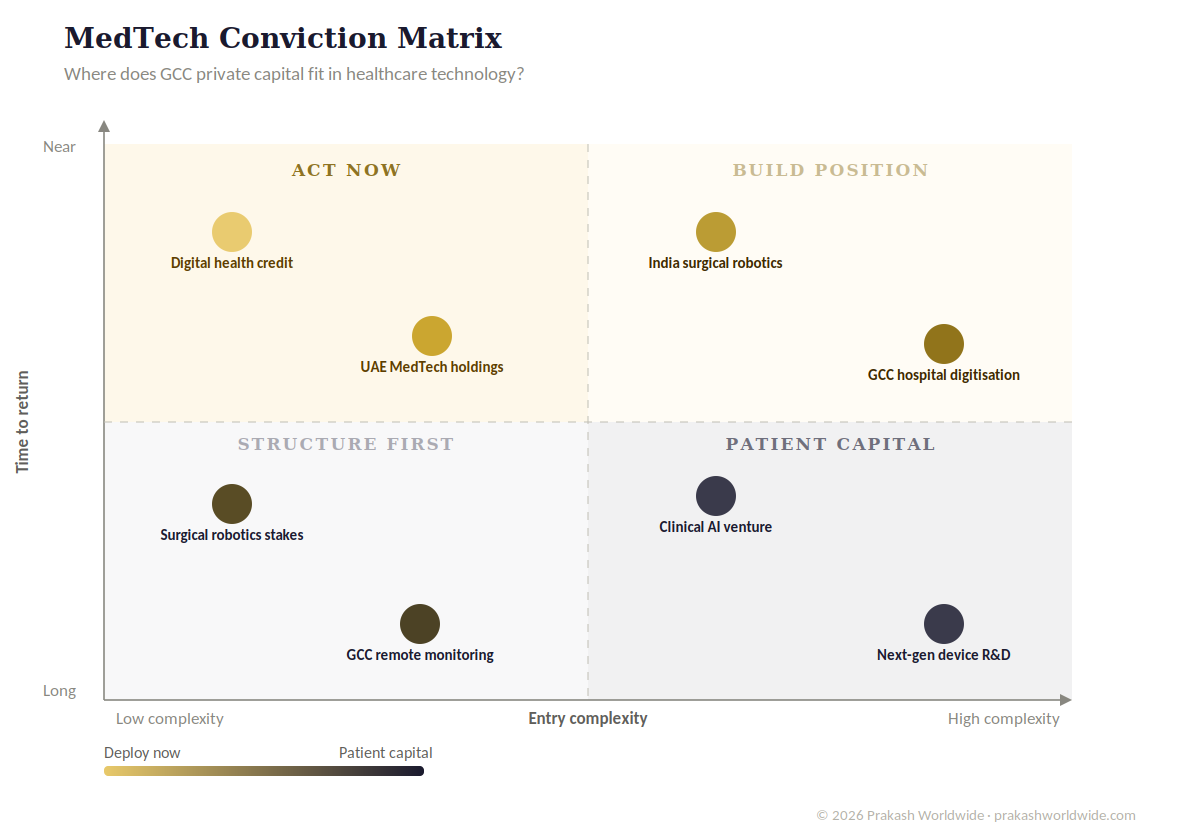
Figure 1: Six MedTech positions mapped by entry complexity and time to return. Colour indicates how soon capital can be deployed.
Part III
Where Precision Matters More Than Enthusiasm
The macro case for GCC MedTech is by now reasonably well understood. Where the returns will actually be made is in the distance between a compelling sector narrative and a defensible investment position. That distance is navigated through specificity. Conviction alone is not enough.
Getting this right requires intelligence that sits between financial analysis and clinical judgment. A diagnostics platform performing well across US hospital networks may face a two-year regulatory pathway before it can operate in Saudi Arabia. A surgical robotics company with strong procedure volumes in Mumbai private hospitals may carry a distribution model that does not translate to Abu Dhabi's procurement structure. Both reward closer examination before any conclusion is drawn.
The regulatory environments across the six GCC states are distinct and moving at different speeds. Saudi Arabia's Health Sector Transformation Programme is opening procurement pathways that private companies are navigating in real time. The UAE, anchored by Malaffi and the Dubai Health Strategy 2026, leads the region in digitisation maturity, though market access here has its own architecture. Bahrain's US free trade agreement opens a different gateway for companies with export ambitions that most investors working the region leave unused. They determine deal structure, entry timing, and exit optionality in ways that surface-level diligence does not catch.
India rewards exactly the same discipline. Local content requirements, pricing dynamics, and regulatory sequencing mean that entry strategies built on direct assumptions tend to disappoint. Entry strategies built around trusted local relationships and a real understanding of how procurement moves tend to hold. GCC investors with existing India exposure, commercial, cultural, through diaspora networks, carry a structural advantage here that purely Western institutional capital has consistently underestimated.
MedTech in this region is a set of related bets, each of which looks different depending on where you stand when you make it.
Prasun Prakash
Founder, Prakash Worldwide
Prakash Worldwide produces intelligence for principals who need to see clearly before they move. If this note raised questions worth pursuing, we are the right conversation to have first.
connect@prakashworldwide.com Get in TouchThis note is produced for informational purposes only and does not constitute investment advice. Prakash Worldwide does not hold positions in any securities referenced herein. © 2026 Prakash Worldwide. All rights reserved.